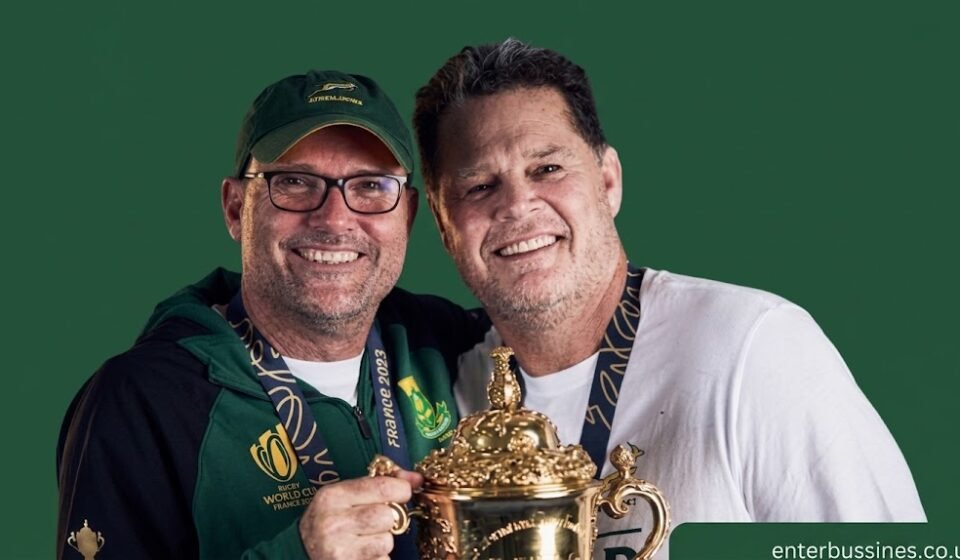

Rassie Erasmus Salary and Net Worth
Rassie Erasmus is one of the most recognizable names in modern rugby. Known around the world for his tactical creativity, demanding standards and unmistakable personality, the South African coach has transformed himself from a former Springbok player into one of the most influential figures in international rugby.
For rugby supporters, the interest in Rassie Erasmus salary and net worth is understandable. His career has included professional playing, provincial coaching, international coaching, rugby administration and leadership at the highest level. His success with the Springboks has also made him one of the most valuable coaching personalities in the sport.
But the Rassie Erasmus story is about considerably more than money.
His journey began in South Africa as a young rugby player. He eventually represented the Springboks, moved into coaching, worked with several major teams and developed a reputation for thinking about rugby differently.
Today, the name Rassie Erasmus is almost synonymous with the modern Springboks.
His coaching philosophy emphasizes preparation, adaptability, discipline, physicality and belief. He has also become famous for his emotional press conferences, strong defense of his players and willingness to challenge established rugby conventions.
This article explores his biography, age, playing career, coaching journey, salary, estimated net worth, family, health, controversies, World Cup achievements and continuing influence on South African rugby.
Who Is Rassie Erasmus?
Rassie Erasmus is a South African rugby coach and former professional rugby player.
His full name is Johan Rassie Erasmus, although the rugby world almost universally knows him simply as Rassie.
He was born on 5 November 1972 in Despatch in the Eastern Cape, South Africa.
Growing up, rugby became an important part of his life. His eventual career would take him from playing provincial rugby to representing the Springboks and later becoming the man responsible for preparing South Africa’s national team.
That journey is one of the most fascinating parts of his biography.
Many successful coaches begin their careers without playing at the highest level. Erasmus had a different background. He experienced professional rugby from inside the dressing room before eventually moving into management.
That experience gave him a unique understanding of the pressures faced by international players.
Rassie Erasmus Age
One of the most common searches about the Springboks coach is “how old is Rassie Erasmus?”
Rassie Erasmus was born on November 5, 1972.
That makes him 53 years old in 2026.
His age is particularly interesting because his most influential coaching achievements have come after decades of involvement in rugby.
Rather than reaching the peak of his career immediately after retirement from playing, Erasmus continued developing his ideas and eventually became one of the sport’s most successful strategists.
His career demonstrates that success in rugby coaching can come from years of accumulated experience rather than simply early fame.
Rassie Erasmus as a Young Rugby Player
Before becoming known as Coach Rassie, Erasmus was a rugby player.
His early career helped establish the foundations for his later coaching philosophy.
He played as a forward, including at flanker, a position that demands physical strength, endurance, discipline and awareness.
Playing in the forward pack requires constant decision-making.
A flanker must understand:
- Defensive positioning
- Breakdown play
- Tackling
- Support running
- Ball carrying
- Set-piece organization
- Communication
- Tactical awareness
Those experiences later became useful when Erasmus moved into coaching.
He knew what it felt like to be under pressure inside a Test match.
He understood the physical demands of rugby.
Most importantly, he knew how quickly a match could change.
Did Rassie Erasmus Play for the Springboks?
Yes.
This is one of the most frequently searched questions about him.
Rassie Erasmus did play for South Africa.
He earned 36 Test caps for the Springboks during his international playing career.
His international career took place between 1997 and 2001.
He was therefore not simply an administrator who later became involved in rugby.
He was a genuine Springbok player.
That distinction is important when understanding his coaching style.
Erasmus knows what it means to wear the green and gold.
He knows the pressure that comes with representing South Africa.
He understands the expectations placed on players by supporters, media and the rugby establishment.
That experience has helped shape the coach he eventually became.
Rassie Erasmus Playing Career
During his playing career, Erasmus represented several South African rugby teams.
His playing history included:
- Free State
- Golden Lions
- Cats
- Stormers
- South Africa
He was known as a physical and intelligent forward.
His time playing Super Rugby was particularly important to his development.
The professional rugby environment taught him how elite teams prepare, how players respond to coaching and how tactical decisions affect matches.
He also experienced leadership responsibilities.
Those experiences became valuable when he eventually moved into coaching.
When Did Rassie Erasmus Play for the Springboks?
Rassie Erasmus played international rugby for South Africa from 1997 to 2001.
During that period, he was part of the Springbok setup during an important era in South African rugby.
He also featured in the 1999 Rugby World Cup.
Years later, he would return to the Rugby World Cup in a completely different role.
Instead of wearing the jersey, he would stand on the sidelines as the man responsible for guiding the team.
That transformation from player to coach is central to his story.
Rassie Erasmus Retires From Playing Rugby
After completing his playing career, Erasmus gradually moved toward coaching.
The transition was not simply a change of job.
It was a change in perspective.
As a player, his responsibility was to perform on the field.
As a coach, his responsibility became much broader.
He had to understand dozens of players, develop tactics, manage personalities, analyze opponents and build an entire team culture.
His playing experience gave him a valuable foundation.
Rassie Erasmus Coaching Career
The coaching career of Rassie Erasmus developed through several stages.
He worked with provincial teams before becoming involved with international rugby.
Among the teams and organizations connected to his coaching journey are:
- Free State Cheetahs
- Western Province
- Stormers
- Munster
- South Africa
- Various South African rugby development structures
Each position gave him additional experience.
The Cheetahs helped establish his reputation.
The Stormers demonstrated his ability to work at Super Rugby level.
Munster gave him international coaching experience.
South Africa ultimately gave him the opportunity to prove himself on the world’s biggest rugby stage.
Rassie Erasmus and the Cheetahs
The Cheetahs played an important role in Erasmus’s development as a coach.
At provincial level, he began experimenting with systems that would later become more sophisticated.
His approach focused heavily on organization.
He wanted players to understand not only what they were supposed to do but why they were doing it.
That philosophy eventually became one of his trademarks.
Rassie Erasmus and the Stormers
Erasmus also became an important figure with the Stormers.
His time with the team helped establish his reputation as one of South Africa’s most promising coaches.
Super Rugby demanded a different level of preparation.
Opponents came from different countries, playing styles varied significantly and matches could be decided by tiny tactical details.
Those experiences helped Erasmus develop into a coach capable of thinking beyond traditional South African rugby structures.
Rassie Erasmus at Munster
Another important stage of his career came when he worked with Munster in Ireland.
His experience with Munster expanded his international reputation.
European rugby provided a different coaching environment from South Africa.
He encountered different playing philosophies, different competition structures and a different rugby culture.
The experience proved valuable when he later returned to South Africa.
It also showed that Erasmus’s coaching ideas could work outside the South African environment.
Rassie Erasmus Becomes South Africa Coach
The biggest opportunity of his career arrived when he became involved with the Springboks coaching structure.
South Africa had experienced a difficult period.
The team needed stability, confidence and a new direction.
Erasmus accepted the challenge.
He understood that simply selecting talented players would not be enough.
The Springboks needed an identity.
They needed belief.
They needed a clear system.
Most importantly, they needed to believe that they could compete with the strongest teams in the world.
Rassie Erasmus and the 2019 Rugby World Cup
The 2019 Rugby World Cup became the defining moment of Erasmus’s first coaching era.
South Africa entered the tournament with serious expectations but also questions surrounding the team’s recent performances.
Erasmus and his coaching staff developed a highly organized approach.
The Springboks combined:
- Powerful forwards
- Strong defense
- Tactical kicking
- Set-piece strength
- Intelligent substitutions
- Physical ball carrying
- Team discipline
The strategy worked.
South Africa reached the final and defeated England.
The Springboks became world champions.
For Erasmus, the victory represented more than a trophy.
It demonstrated that his coaching philosophy could succeed at the highest possible level.
The Birth of the Modern Springboks
The 2019 success changed the perception of South African rugby.
The Springboks were no longer simply a physically powerful team.
They became tactically sophisticated.
One of the most recognizable features of the Erasmus era was the use of the bench as a strategic weapon.
This eventually became associated with the famous “Bomb Squad.”
The idea was simple but powerful.
Instead of treating replacements merely as players who enter when someone becomes tired or injured, the Springboks could use their bench to dramatically change the intensity of a match.
Fresh forwards could enter and maintain or increase physical pressure.
That concept became one of the most discussed aspects of modern rugby.
Rassie Erasmus and Jacques Nienaber
Rassie Erasmus’s story cannot be separated from Jacques Nienaber.
Nienaber was a key member of the Springbok coaching structure and later became head coach.
The two developed a strong professional partnership.
Erasmus’s broader strategic thinking worked alongside Nienaber’s expertise, particularly in defensive systems.
After the 2019 World Cup, Nienaber took the head-coaching position while Erasmus moved into a director-of-rugby role.
The partnership continued to produce results.
The 2023 Rugby World Cup
The 2023 Rugby World Cup provided another extraordinary chapter.
South Africa arrived as defending champions.
The pressure was enormous.
Winning one World Cup is difficult.
Defending the title is even harder.
The Springboks once again demonstrated exceptional resilience.
They survived extremely tight matches and ultimately reached the final.
South Africa defeated New Zealand to win the Rugby World Cup again.
The victory established the Springboks as the most successful nation in Rugby World Cup history at that point, with four titles.
For Erasmus, the achievement further strengthened his reputation.
Rassie Erasmus Returns as Springboks Coach
After spending time in a broader leadership role, Erasmus returned as head coach.
His second stint was highly anticipated.
By then, he had already become one of the biggest names in world rugby.
The challenge was different from 2018.
This time he was not rebuilding a struggling team.
He was maintaining a champion team.
That can sometimes be even more difficult.
Success creates expectations.
Every loss becomes a major story.
Every selection decision is analyzed.
Every press conference becomes news.
Erasmus embraced that pressure.
How Long Has Rassie Been Springbok Coach?
The answer depends on how his different roles are counted.
Erasmus first became Springbok head coach in 2018.
He held the role through the 2019 Rugby World Cup.
After that tournament, he moved into a broader director-of-rugby position while Jacques Nienaber became head coach.
Erasmus later returned to the head-coaching position.
Therefore, it is more accurate to describe his time with South African rugby as a long-running leadership role rather than saying he has continuously served as head coach since 2018.
His influence, however, has remained significant throughout the period.
Rassie Erasmus Salary
The question of Rassie Erasmus salary attracts enormous attention.
His exact salary has not been publicly confirmed in a detailed official compensation statement.
However, media estimates have frequently placed his annual earnings around the £650,000 mark.
That would put him among the highest-paid coaches in international rugby.
His earnings reflect several factors.
First, he has exceptional results.
Second, he has extensive international experience.
Third, he carries enormous responsibility.
Fourth, his reputation has grown substantially since the 2019 World Cup.
A coach who has won multiple World Cups naturally commands a different market value from a coach who is still trying to establish himself.
How Much Does Rassie Erasmus Earn?
There is no universally confirmed public figure.
Estimates vary depending on the publication and what is included in the calculation.
Some reports place his annual coaching income at approximately £650,000.
Other estimates have suggested higher figures when bonuses and other compensation are considered.
Therefore, the most responsible way to describe his earnings is to say that Rassie Erasmus is believed to be one of the better-paid coaches in international rugby, but his exact salary is private.
Rassie Erasmus Net Worth
The exact Rassie Erasmus net worth is also not publicly established.
Online estimates vary considerably.
Some estimates place his wealth in the lower single-digit millions of US dollars.
Other publications have suggested figures above R100 million in South African rand.
Such differences are common in celebrity net-worth reporting because private assets, investments, property, taxes and contracts are not fully visible to the public.
Therefore, no single internet estimate should be treated as an official figure.
A reasonable description is that Erasmus has accumulated substantial wealth through a long career in professional rugby, high-level coaching and leadership.
How Did Rassie Erasmus Build His Wealth?
Rassie Erasmus’s wealth has developed over decades rather than from one single contract.
His potential income sources include:
Professional rugby
His playing career provided his first experience of professional earnings.
Coaching
His coaching career became his primary professional occupation.
International leadership
Working with the Springboks placed him among the most important rugby professionals in the country.
Director of Rugby responsibilities
His leadership role involved responsibilities beyond ordinary coaching.
Books and media
His story and rugby philosophy have also attracted attention through publishing and media.
Commercial opportunities
His international profile creates opportunities that were not available to him earlier in his career.
Rassie Erasmus Contract
A long-term contract is important because it gives both the coach and the national rugby organization stability.
Erasmus’s continued relationship with South African rugby demonstrates how highly his contribution is valued.
His future has been connected with the Springboks’ long-term plans leading toward the 2031 Rugby World Cup.
That means South Africa has chosen continuity rather than beginning another major coaching transition.
Rassie Erasmus Coaching Record
The coaching record of Rassie Erasmus includes achievements at provincial, franchise, European and international levels.
Some of the most important milestones include:
- Developing successful provincial teams
- Reaching the Super Rugby final with the Stormers
- Coaching Munster
- Rebuilding the Springboks
- Winning the 2019 Rugby World Cup
- Winning the 2019 World Rugby Coach of the Year award
- Helping establish the modern Springbok system
- Being part of the 2023 World Cup-winning setup
- Returning as Springbok head coach
That record explains why he is frequently described as one of the greatest coaches in South African rugby history.
Rassie Erasmus Controversy
Success has not protected Erasmus from controversy.
In fact, controversy has become part of his public image.
His willingness to criticize refereeing and rugby authorities has made him one of the most debated coaches in the sport.
Supporters see him as someone who protects his players and challenges unfairness.
Critics believe his approach can sometimes cross the line.
Either way, he rarely generates indifference.
Rassie Erasmus Banned
The most famous disciplinary controversy involved his criticism of match officiating during the British & Irish Lions series.
The incident became a major story in international rugby.
World Rugby subsequently imposed disciplinary sanctions.
The episode created a wider debate about:
- Coaches and referees
- Social media
- Professional criticism
- Match-official protection
- Freedom of expression
- Rugby governance
It also changed the way Erasmus was viewed internationally.
Some people saw him as rebellious.
Others saw him as reckless.
Many South African supporters, however, viewed his actions as evidence that he was prepared to defend his team.
Rassie Erasmus and Nic Berry
Nic Berry became a central figure in the controversy.
The Australian referee officiated the first Test of the British & Irish Lions series.
Erasmus subsequently expressed strong dissatisfaction with aspects of the officiating.
The incident escalated into a World Rugby disciplinary matter.
It remains one of the most talked-about chapters of his coaching career.
Rassie Erasmus Waterboy
The phrase “Rassie Erasmus waterboy” became another memorable part of his story.
During the Lions series, Erasmus was involved in an unusual sideline role.
The situation attracted enormous attention because it blurred the traditional boundaries between coaching and match-day support.
It became symbolic of Erasmus’s unconventional approach.
He has repeatedly demonstrated that he is willing to think outside traditional rugby structures.
Rassie Erasmus Speech
Rassie’s speeches have become part of his identity.
Whether addressing players, journalists or supporters, he tends to communicate with intensity.
His messages often revolve around:
- Teamwork
- Responsibility
- Sacrifice
- Preparation
- Belief
- National pride
- Respect
- Resilience
His speeches are especially powerful after major victories.
The emotional nature of the Springbok environment means that coaching communication can be just as important as tactical preparation.
Rassie Erasmus Quotes
Many Rassie Erasmus quotes revolve around team culture.
One of the strongest themes associated with him is that no individual is bigger than the Springboks.
That principle helps explain why South Africa has been able to rotate players without completely losing its identity.
The coach wants every player to understand that the team comes first.
Rassie Erasmus Family
Rassie Erasmus has generally kept his personal life away from the rugby spotlight.
He has children and has historically maintained a relatively private family life.
That privacy is understandable given the enormous attention surrounding his professional career.
The public knows far more about his rugby philosophy than his everyday family life.
Rassie Erasmus Wife
The name Nicolene Erasmus is frequently associated with the coach’s personal life.
Information about their relationship has circulated widely online, including reports concerning their marital status.
However, personal matters should be treated carefully because social-media claims can easily become exaggerated.
Erasmus himself has traditionally preferred to keep his family away from the center of his professional profile.
Rassie Erasmus Daughter
Rassie Erasmus has daughters, and his family has occasionally appeared in public discussions surrounding his life.
However, his children are not rugby celebrities themselves.
That means it is more appropriate to focus on Erasmus’s professional achievements rather than speculate about the private lives of his children.
Rassie Erasmus Health
Health has also been a subject of interest among supporters.
Erasmus experienced a serious health challenge during his career, which brought attention to his personal resilience.
The topic has led to repeated searches for phrases such as:
- Rassie Erasmus health
- Rassie Erasmus illness
- Is Rassie Erasmus sick?
- Rassie Erasmus disease
It is important to distinguish historical health information from claims about someone’s current condition.
A search trend does not automatically mean a person is currently ill.
Rassie Erasmus and South African Rugby
Perhaps the biggest reason for Erasmus’s importance is the way he has influenced South African rugby as a whole.
He has helped create a system rather than simply coaching a single team.
His influence can be seen in:
- Player development
- Tactical preparation
- Coaching structures
- Squad depth
- Leadership
- Defensive systems
- Forward strategy
- Match-day substitutions
The modern Springboks are therefore larger than one individual.
But Erasmus has played a major role in creating their identity.
South African Rugby Coaching Staff
International rugby requires a large coaching team.
The head coach works alongside specialists in:
- Attack
- Defence
- Scrums
- Lineouts
- Skills
- Fitness
- Analysis
- Conditioning
- Medical preparation
- Player welfare
Rassie Erasmus’s success has come partly from his ability to coordinate specialists rather than attempting to do everything himself.
That is one reason his role has evolved beyond the traditional idea of a head coach.
Former Springbok Coaches
South Africa has had many notable rugby coaches.
The list of previous Springbok coaches includes names such as:
- Kitch Christie
- Nick Mallett
- Harry Viljoen
- Rudolf Straeuli
- Jake White
- Peter de Villiers
- Heyneke Meyer
- Allister Coetzee
- Rassie Erasmus
- Jacques Nienaber
Each coach inherited a different team and faced different challenges.
However, Erasmus has created a particularly strong legacy because of the number of major titles associated with his era.
Rassie Erasmus and Jake White
Jake White is one of the most important comparisons.
White coached South Africa to the 2007 Rugby World Cup title.
Erasmus later helped guide the Springboks to World Cup glory in the modern era.
Both coaches demonstrated that South Africa’s strength can be built around detailed preparation, strong forward play and tactical discipline.
The comparison between them will probably continue for many years.
Rassie Erasmus and Heyneke Meyer
Heyneke Meyer coached the Springboks during the early 2010s.
His tenure included a Rugby World Cup semifinal appearance.
Meyer was known for a powerful forward-oriented style.
Erasmus inherited a South African team that needed rebuilding several years later.
Their eras were different, but both contributed to the development of South African rugby.
Rassie Erasmus and Allister Coetzee
Allister Coetzee was the Springbok coach immediately before Erasmus’s first tenure.
South Africa experienced a difficult period under Coetzee.
When Erasmus arrived, he faced the challenge of restoring confidence.
The speed of the transformation became one of the most impressive parts of his coaching story.
Within a relatively short period, South Africa went from uncertainty to becoming world champions.
Rassie Erasmus and the Best South African Scrum-Half Debate
The Springboks have produced many outstanding scrum-halves.
Names such as Faf de Klerk, Fourie du Preez, Cobus Reinach and others have played important roles in South African rugby.
Erasmus has demonstrated that he is willing to select different players depending on tactical requirements.
This is another feature of his coaching philosophy.
Rather than automatically selecting the most famous player, he looks at how each individual fits into the game plan.
Cobus Reinach and the Stormers Connection
Cobus Reinach has become one of the recognized scrum-half names in South African rugby.
Like many international players, his career has crossed different professional environments.
The broader point is that Erasmus has consistently worked with talented South African players from different provincial and international backgrounds.
His selection philosophy emphasizes tactical fit.
Rassie Erasmus and 2026
The modern era of Rassie Erasmus continues to develop.
South Africa remains one of the strongest rugby nations in the world.
The competition with New Zealand remains particularly important.
Erasmus’s teams continue to emphasize physicality while also adding attacking variation.
His ability to adapt has arguably become one of his greatest strengths.
Why Rassie Erasmus Remains Successful
There are several reasons for his longevity.
He understands players
Having been a Springbok himself, Erasmus knows the pressure players face.
He prepares extensively
His teams rarely enter major matches without detailed preparation.
He embraces tactical innovation
He is willing to experiment.
He builds depth
The Springboks can call upon many high-quality players.
He protects his team
His supporters appreciate his willingness to defend players publicly.
He understands psychology
Modern rugby requires mental strength as well as physical ability.
Rassie Erasmus Documentary Potential
The career of Rassie Erasmus would make an extraordinary documentary.
A full documentary could explore:
Chapter One: Childhood in the Eastern Cape
Chapter Two: Becoming a rugby player
Chapter Three: The Springbok playing career
Chapter Four: Moving into coaching
Chapter Five: The Cheetahs and Stormers
Chapter Six: Munster
Chapter Seven: Rebuilding South Africa
Chapter Eight: The 2019 World Cup
Chapter Nine: The controversy
Chapter Ten: The 2023 World Cup
Chapter Eleven: Returning as head coach
Chapter Twelve: The road toward 2031
It is a story containing sporting triumph, controversy, emotion and reinvention.
Rassie Erasmus Book
His book, Rassie: Stories of Life and Rugby, offers another perspective on his journey.
The title itself reflects how closely his personal identity has become connected to rugby.
For fans, a book about Erasmus is interesting because his career cannot be reduced to match results.
His philosophy comes from decades of experiences.
Rassie Erasmus Instagram and Twitter
Social media has become another important part of the modern rugby environment.
Fans regularly search for Rassie Erasmus Instagram, Rassie Erasmus Twitter, videos, interviews and press conferences.
His online presence has attracted attention because of his strong opinions and willingness to communicate directly.
However, fans should always distinguish official accounts from fan-created pages.
There are many accounts using famous rugby personalities’ names.
Rassie Erasmus Interview Style
A Rassie Erasmus interview is rarely predictable.
He can discuss tactics one minute and broader rugby culture the next.
His interviews often contain humor, frustration, honesty and strong opinions.
That makes him highly watchable.
It also explains why clips of his interviews frequently circulate online.
Rassie Erasmus Crying and Emotional Moments
Although Erasmus is known for his intense personality, he has also shown emotional vulnerability.
World Cup victories are emotional moments for coaches as well as players.
For a coach who has invested years into a team, watching the players achieve their ultimate goal can be overwhelming.
Those emotional moments have helped supporters see another side of him.
Behind the tactical mind is someone deeply invested in the people he coaches.
Rassie Erasmus as a Leader
Leadership may ultimately become the most important part of his legacy.
He has demonstrated that leadership does not always mean being conservative.
Sometimes leadership involves taking risks.
Sometimes it means defending your players.
Sometimes it means accepting criticism.
And sometimes it means making an unpopular decision because you believe it is right for the team.
That philosophy has become closely associated with Erasmus.
The Future of Rassie Erasmus
The future of Erasmus is likely to remain closely connected with South African rugby.
The next major target is the 2031 Rugby World Cup.
That gives him an opportunity to create an even longer legacy.
The challenge will be maintaining the Springboks’ standards while developing new generations of players.
International rugby changes rapidly.
Players retire.
Young stars emerge.
Tactics evolve.
Opponents learn.
The coach who succeeds today cannot simply repeat yesterday’s plan.
That is why Erasmus’s ability to adapt will be crucial.
Final Thoughts
Rassie Erasmus has travelled an extraordinary road.
He started as a young South African rugby player.
He became a Springbok.
He moved into coaching.
He worked with provincial teams.
He gained experience in Europe.
He returned to South Africa.
He rebuilt the Springboks.
He won the Rugby World Cup.